

If you have ever stood in front of your bathroom mirror wondering whether your vitamin C serum belongs in your morning routine or your nighttime lineup, you are definitely not alone. It is one of the most common skincare debates out there. The short version? Morning wins, and there is real science to back it up.
What Exactly Does Vitamin C Do for Your Skin
Vitamin C, or L-ascorbic acid, is one of the most studied skincare ingredients available today. It sits right below retinoids in terms of research behind it.
At its core, vitamin C is an antioxidant. It fights off free radicals, which are unstable molecules that damage your skin cells. These free radicals come from air pollution, cigarette smoke, and ultraviolet radiation from the sun.
When free radicals go unchecked, they chip away at your collagen and speed up aging. Vitamin C steps in and neutralizes them before they can do damage. On top of that, it boosts collagen production, brightens your complexion, and helps fade dark spots.
According to Harvard Health, daily use of a vitamin C formulation for at least three months can improve the appearance of wrinkles and overall skin texture.
Why Morning Application Gives You the Biggest Advantage
Vitamin C does not just repair damage. Its greatest superpower is preventing damage in the first place. And when does your skin face the most environmental assault? During the day.
Every time you walk outside, your skin gets bombarded with UV rays and pollution. Your sunscreen blocks most of that, but no sunscreen catches everything. Vitamin C becomes your second line of defense.
Research published in the journal Acta Dermato-Venereologica found that combining vitamin C with sunscreen produced a protective effect greater than what you would expect from simply adding the two together. They do not just work side by side. They amplify each other.
If you only use vitamin C before bed, you are leaving its most impressive benefit on the table.
The Science Behind Free Radicals and Why Daytime Matters
UV radiation creates oxidative stress in your skin. Sunlight breaks apart stable electron pairs in your skin cells, creating free radicals that attack collagen fibers, damage cell membranes, and mess with your DNA.
Research from the Linus Pauling Institute confirms that UV light actively decreases the vitamin C content in your skin. Your skin transport proteins for vitamin C increase in response to UV light, meaning your skin needs more vitamin C when the sun hits it.
At night, your skin is not dealing with UV radiation or heavy pollution. It goes into recovery mode. While vitamin C can support nighttime repair, the urgent defensive role is most needed during daylight hours.
Think of it this way. You would not put on your armor after the battle is over.
Vitamin C and Sunscreen Are the Ultimate Morning Power Couple
These two together create something genuinely more powerful than either one alone.
Sunscreen acts as a barrier, absorbing or reflecting UV rays. But some rays still get through. Vitamin C catches those by neutralizing the free radicals they create.
Research chemist Kerry Hanson found that vitamin C is the most effective free radical neutralizer among antioxidants and that regular use builds up a protective reservoir within your skin.
Studies on pig skin showed impressive results when vitamin C was combined with other antioxidants before sun exposure:
- 15 percent ascorbic acid alone doubled the UV needed to cause redness
- Adding 1 percent vitamin E doubled that protection again
- Adding 0.5 percent ferulic acid doubled it once more
Sunscreen alone is good. Vitamin C underneath it is great. Combining vitamin C with vitamins E and ferulic acid before your SPF is elite level protection.
| Factor | Morning Application | Nighttime Application |
|---|---|---|
| UV Protection | Actively fights free radicals from sun exposure | No UV exposure to protect against |
| Sunscreen Synergy | Amplifies SPF protection significantly | No sunscreen interaction at night |
| Pollution Defense | Shields against daytime environmental stressors | Minimal pollution exposure while sleeping |
| Brightening Effect | Creates a glowing base under makeup | You will not see the brightness until morning |
| Collagen Support | Active during the day and continues working | Supports nighttime repair processes |
| Compatibility | Pairs easily with moisturizer and SPF | May conflict with retinol or exfoliating acids |
| Absorption | Lightweight and layers well under products | Nighttime products tend to be thicker |
| Depot Effect | Builds protective reservoir for daytime use | Some residual protection carries to next day |
Morning application covers more bases. If you are only going to use vitamin C once a day, morning gives you the best return.
The Depot Effect and Why One Morning Application Lasts Longer Than You Think
Vitamin C has what researchers call a depot effect. Once it absorbs into your skin, it does not disappear after a few minutes. It accumulates and stays active for an extended period.
In studies on pig skin, a single application remained active for up to 72 hours. Human skin might not retain it quite that long, but the principle holds.
Kerry Hanson confirmed that the best results came after repeated applications when a significant amount of vitamin C had accumulated in the skin. At that point, free radicals get neutralized by the vitamin C already stored in your skin layers.
You are building up a protective reserve right when your skin needs it most.
How to Apply Vitamin C in Your Morning Routine

Getting the timing right is one thing, but the order of application matters too. Here is the ideal morning sequence.
Cleanse Your Face:
Start with a gentle cleanser to remove oils, sweat, and dead skin cells from overnight. You want a clean surface so vitamin C can penetrate properly.
Apply Toner if You Use One:
A hydrating toner can balance your skin pH and prep it for better serum absorption. This step is optional.
Apply Your Vitamin C Serum:
Take two to three drops and gently press it into your face and neck. Give it a minute or two to sink in before the next step.
Moisturize:
Follow up with moisturizer to lock in hydration. This creates a smooth layer between your serum and sunscreen.
Sunscreen Which Is Non Negotiable:
Finish with broad spectrum sunscreen of at least SPF 30. Never skip this step. Vitamin C enhances sun protection but does not replace sunscreen.
Common Mistakes People Make With Morning Vitamin C
- Using a Product That Has Gone Bad: Vitamin C is unstable. When it breaks down, it turns from clear to yellow, then orange, then brown. If your serum has darkened, it is likely oxidized and less effective. Store it in a cool dark place and replace it every two to three months.
- Applying Too Much: Your skin can only absorb so much at once. Two to three drops is plenty. Anything extra sits on the surface and goes to waste.
- Skipping Sunscreen After Application: Applying vitamin C without sunscreen is like wearing half a seatbelt. You get some protection but miss the full benefit. These two are meant to work together.
Mixing It With the Wrong Ingredients:
Avoid layering vitamin C with these in the same routine:
- AHAs and BHAs which reduce its effectiveness
- Benzoyl peroxide which oxidizes vitamin C and cancels its benefits
- Strong exfoliants that can cause irritation when combined
Save those ingredients for a different time of day.
What About Using Vitamin C at Night
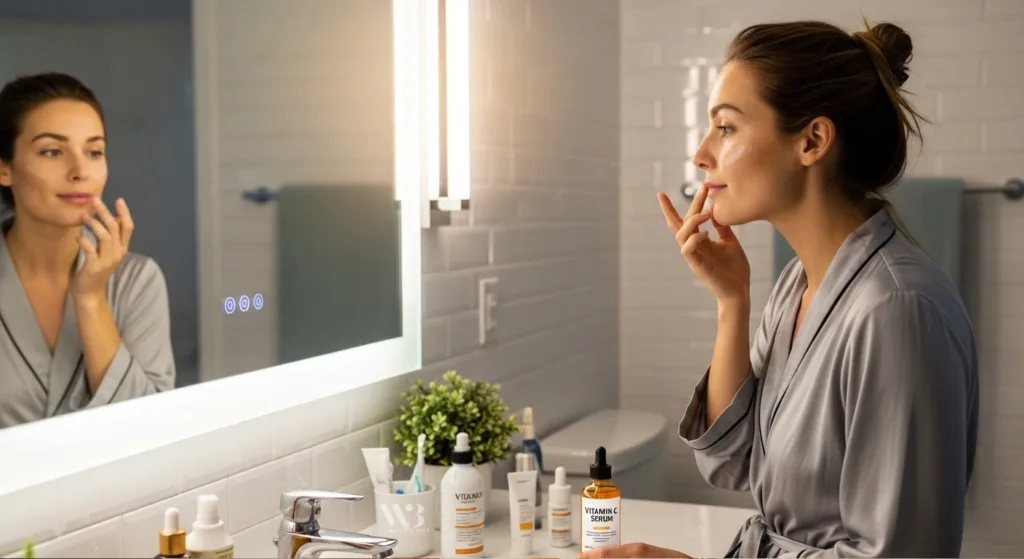
Using vitamin C at night is not a mistake. It still brightens skin, supports collagen, and fades dark spots.
At night, your skin shifts into repair mode and cell turnover increases. Vitamin C can support this process by encouraging collagen synthesis while you sleep.
However, nighttime routines tend to get crowded with active ingredients like retinol and exfoliating acids. Vitamin C can clash with some of these and cause sensitivity.
If your skin tolerates it, using vitamin C both morning and night is perfectly fine. But if you are choosing just one time, morning wins.
Who Should Be Careful With Morning Vitamin C
Most skin types handle morning vitamin C without issues. But there are a couple of situations to consider.
People with very sensitive skin sometimes find that the low pH of vitamin C products causes tingling or redness that gets worse with sun exposure. If that sounds like you, try these adjustments:
- Start with a lower concentration around 5 percent
- Work your way up gradually over several weeks
- Try a gentler derivative like magnesium ascorbyl phosphate
- Always do a patch test on your inner arm before applying to your face
Final Thoughts
The reason why vitamin C in the morning is considered the ideal time for skincare comes down to protection. Your skin faces UV radiation, pollution, and environmental stress every single day, and vitamin C is built to fight all of that in real time. Pair it with sunscreen and you get a defense system stronger than either product alone. If you are picking just one time to use it, make it the morning. Your skin will thank you for years to come.


About author

Add comment