
A tungsten ring costs $8 to make. You pay $200. It’s marketed as “indestructible” but shatters if you drop it. The wood ring you bought for $300 is 60% petroleum-based resin and needs refinishing in 18 months. That “natural” antler ring? More plastic than bone, and it’ll crack within three years.
Welcome to the men’s ring industry, where aerospace-grade means nothing, scratch-proof rings break, and “natural materials” are soaked in chemicals.
How We Got Here: The Alternative Materials Timeline
- 2010-2012: Tungsten rings explode in popularity as “affordable alternatives” to gold
- 2013-2015: Titanium marketed as “aerospace technology” for your finger
- 2016-2018: Wood and antler rings trend as “natural, eco-friendly choices”
- 2019-2020: Every jeweler discovers “sustainable” and slaps it on existing products
- 2021-2025: Market hits $9.72 billion with 2,000-5,000% markups nobody questions
The men’s jewelry market grew from niche to $48.56 billion by 2024. Alternative materials weren’t chosen for performance. They were chosen because profit margins on $8 tungsten rings sold for $200 beat gold every time.
Tungsten Carbide: The “Indestructible” Metal That Shatters
What They Tell You
- Scratch-proof and virtually indestructible
- Harder than titanium and steel
- Maintains its polish forever
- Aerospace and industrial strength
- Sustainable and ethically sourced
What Actually Happens
The Scratch-Proof Lie: Tungsten carbide ranks 9 on the Mohs hardness scale—second only to diamond. It won’t scratch from daily wear. But here’s what they don’t mention: it’s brittle. Drop a tungsten ring on concrete and it can shatter. Not bend. Shatter.
Emergency rooms keep diamond-coated pliers specifically for removing tungsten rings because they can’t be cut—they have to be cracked off your finger.
The Cost Reality:
- Manufacturing cost: $8-12 per ring
- Retail price: $100-400
- Average markup: 2,000%
- Material composition: 80-85% tungsten carbide, 15-20% nickel binder
The Sustainability Myth:
Tungsten will be depleted in 40 years at current consumption rates. Only 30-35% gets recycled. Manufacturing requires temperatures over 2,200°C. The Chinese mines that produce 60% of global supply (23,000 metric tons annually) are the same mines supplying both “ethical” and regular tungsten.
Your “ethically sourced” tungsten ring came from the same place as the cheap one.
The Environmental Reality:
| Impact Factor | Amount |
|---|---|
| Manufacturing temperature | 2,200°C+ |
| CO2 equivalent per kg | 12,200 kg |
| Energy for Chinese production | 166 MJ per ring |
| Current recycling rate | 30-35% |
| Years until depletion | 40 years |
Health Concerns They Skip: Hard Metal Lung Disease is a real condition caused by exposure to tungsten carbide and cobalt particles. Not a concern for wearing the ring, but worth knowing the material’s industrial hazards.
The Real Issues
- Cannot be resized. Ever. Your finger changes size? Buy a new ring.
- Low resale value: 20-30% of purchase price. That $250 tungsten ring? Worth $50-75 used.
- Emergency removal: Requires special tools to crack it off. Some emergency rooms aren’t equipped.
- Weight: Tungsten is the heaviest metal commonly used in rings. Some love it. Many find it uncomfortable
Titanium: The “Aerospace-Grade” Metal That Scratches
What They Tell You
- Aerospace-grade strength
- Hypoallergenic and safe
- Lightweight and comfortable
- Sustainable and eco-friendly
- Premium modern metal
What’s Really Happening
The Aerospace-Grade Scam: Know what else is aerospace-grade? The aluminum in your soda can. “Aerospace-grade” isn’t a quality designation—it’s a marketing term. There’s no certification or standard that makes titanium special for jewelry.
Aircraft-grade titanium (Ti-6Al-4V) costs $7,500 per metric ton. Your ring uses maybe 10 grams. Material cost: $0.08
The Scratch Reality:
Titanium is softer than tungsten. It scratches. One jeweler’s honest assessment: “After 4 years it’s very scratched.” Titanium rings can be refinished, but many jewelers charge $35-50 for the service—a service you’ll need regularly.
The True Costs:
- Manufacturing cost: $12-20 per ring
- Retail price: $100-500 (average $150-250)
- Material cost: Less than $1
- Markup: 1,000-2,000%
The Sustainability Half-Truth:
Titanium produces 12 tons of CO2 per ton of metal through the Kroll process. Recycling saves 95% of that energy—but 90% of titanium minerals go into TiO2 pigment (paint, plastics, cosmetics), which can’t be recycled.
The titanium jewelry market is a fraction of total production. Your “sustainable” choice barely moves the needle.
The Real Durability
| Property | Tungsten | Titanium | Reality Check |
|---|---|---|---|
| Hardness | 9 (Mohs) | 6 (Mohs) | Gold is 2.5-3 |
| Scratching | Highly resistant | Scratches easily | Both need maintenance |
| Impact | Shatters | Dents but flexes | Tungsten breaks, titanium survives |
| Weight | Heaviest common metal | 40% lighter than steel | Preference based |
| Resizing | Impossible | Impossible (usually) | Both require new ring |
| Refinishing | Cannot be refinished | Can be repolished | Tungsten advantage lost |
Cannot be resized in most cases. Some jewelers can size metal-banded titanium rings up half a size. That’s it.
Resale value: 40-50% of purchase price. Better than tungsten, worse than precious metals.
Wood Rings: The “Natural” Rings Made of Plastic
What They Tell You
- Natural, organic, eco-friendly
- Each ring is unique with natural grain
- Connection to nature
- Sustainable choice
- Beautiful and warm aesthetic
The Truth They’re Hiding
Wood rings are 60%+ petroleum-based epoxy resin.
That’s not a natural ring with some protective coating. That’s a plastic ring with wood veneer. The resin-to-wood ratio in most “wood rings” means you’re wearing more fossil fuels than forest.
The Construction Reality:
- Solid wood rings: Wood soaked in stabilizing resin, then shaped and coated with more resin. The wood is essentially plastic-impregnated.
- Inlay wood rings: Thin wood veneer between metal or resin layers, sealed with epoxy coating.
- Bentwood rings: Multiple thin layers wrapped and sealed—requires the most resin.
The Maintenance Nobody Mentions
Required every 2 weeks:
- Clean with mild soap
- Apply protective wax or oil
- Inspect for damage
Required every 6-18 months:
- Professional refinishing
- Re-sealing with epoxy
- Fixing cracks or delamination
Must remove for:
- Hand washing (for non-sealed versions)
- Swimming, showering, bathing
- Dishwashing
- Exercise (sweat damages finish)
- Cleaning with chemicals
- Temperature extremes
Lifespan reality: 18 months to 5 years before major refinishing needed. With extreme care and regular maintenance, some last longer. Most don’t.
The Cost Breakdown
| Component | Cost | Retail Price | Markup |
|---|---|---|---|
| Raw wood | $0.50-2 | – | – |
| Epoxy resin | $1-3 | – | – |
| Metal core (if used) | $2-5 | – | – |
| Total materials | $2-6 | $150-400 | 2,500-6,500% |
The $300 wood ring costs $4 to make.
What Really Happens
- Year 1: Looks beautiful. Requires weekly maintenance. You’re careful with it.
- Year 2: Finish showing wear. Need professional refinishing ($50-100). Remove for most activities.
- Year 3: Wood starting to crack. Epoxy bubbling. Options: refinish again or replace.
- Year 4: If you’ve been religious about maintenance, still looks okay. Most people replace it.
One craftsman’s honest assessment: “Natural wood rings are more susceptible to water damage and scuffing than your average metal or carbon fiber ring. If you plan to be swimming or rock climbing with a wood ring on, then this material probably isn’t the best choice.”
Translation: It’s a special-occasion ring that requires constant care.
Antler Rings: The “Natural” Bone Soaked in Resin
What They Tell You
- Made from naturally shed antlers (ethical)
- Unique natural patterns
- Eco-friendly and sustainable
- Rugged and outdoorsy
- Connection to nature
What They’re Not Telling You
Antler is porous bone stabilized in plastic resin. The finished ring contains more petroleum-based resin than actual antler. It’s marketed as natural but manufactured like any other composite material.
The Stabilization Process They Skip
- Raw antler (naturally shed—this part is true)
- Vacuum-infused with stabilizing resin (petroleum product)
- Oven-baked to cure the resin
- Shaped and polished
- Sealed with protective resin coating (more petroleum)
- Optional: encased in tungsten or titanium sleeve
The antler you see is essentially plastic-impregnated bone with a plastic coating. Three separate resin applications in most cases.
The Durability Disaster
Antler properties:
- Porous (absorbs moisture and oils)
- Organic material (degrades over time)
- Bone structure (can crack)
- Resin-dependent (fails when coating fails)
What causes failure:
- Moisture causes sealant to bubble and peel
- Skin oils saturate the porous bone
- Once oil-saturated, water-based sealants won’t adhere
- Temperature changes cause expansion/contraction
- Impact cracks the bone structure
- Smells if it gets wet (organic material decay)
The Maintenance Reality
Required every 2 weeks:
- Gentle cleaning with mild soap
- Waxing with beeswax
- Inspection for cracks or moisture damage
Must remove for:
- Hand washing
- Swimming, showering, bathing
- Dishwashing
- Exercise and physical labor
- Exposure to chemicals (including hand sanitizer)
- Sleeping
Lifespan by type:
| Ring Type | Durability | Recommended Use | Lifespan |
|---|---|---|---|
| Solid antler (resin-stabilized) | Low | Occasional wear | 2-3 years |
| Reinforced antler (with metal) | Medium | Careful daily wear | 3-5 years |
| Antler inlay (antler in metal core) | Highest | Daily wear possible | 4-7 years with care |
Fully carved antler rings: Special occasion only. Cannot handle daily wear. 4-5+ years with touch-ups if worn occasionally.
One maker’s honest take: “The fully carved rings are pieces of wearable art… but do not make the best engagement or wedding rings because of the special care required and because they truly should not be worn daily.”
The Cost Mathematics
| Component | Cost | Retail Price | Markup |
|---|---|---|---|
| Raw antler | $2-4 | – | – |
| Resin stabilization | $1-2 | – | – |
| Metal sleeve (if used) | $8-15 | – | – |
| Total materials | $3-6 (solid) | $200-500 | 3,300-8,300% |
| With metal | $11-21 | $300-600 | 1,400-2,700% |
Many companies include a “free backup silicone ring” with antler ring purchases. That’s not generosity. That’s acknowledging their product fails.
Antler Density Hierarchy
- Whitetail deer: Hardest and most durable. White appearance. Most expensive.
- Elk antler: Tied with mule deer for density. Large antlers (10+ pounds). Mid-range durability.
- Mule deer: Similar to elk. Darker color. Mid-range durability.
- Moose antler: Softest. Highest marrow content. Least durable. Cheapest.
The Comparison Nobody Makes: What Actually Matters
Durability Over Time
5-Year Reality Check:
| Material | Year 1 | Year 3 | Year 5 | Total Cost |
|---|---|---|---|---|
| Tungsten | Perfect | Perfect | Perfect unless dropped | $200 (replaced if broken) |
| Titanium | Minor scratches | Noticeable wear | Needs refinishing | $250 + $50 refinishing |
| Wood | Good with care | Refinished once | Second refinishing or replaced | $300 + $100-200 maintenance |
| Antler | Good with extreme care | Showing damage | Likely replaced | $400 + replacement |
| Gold (comparison) | Scratched but intact | Scratched but intact | Can be refinished infinitely | $800-1,200 |
The Real Sustainability Score
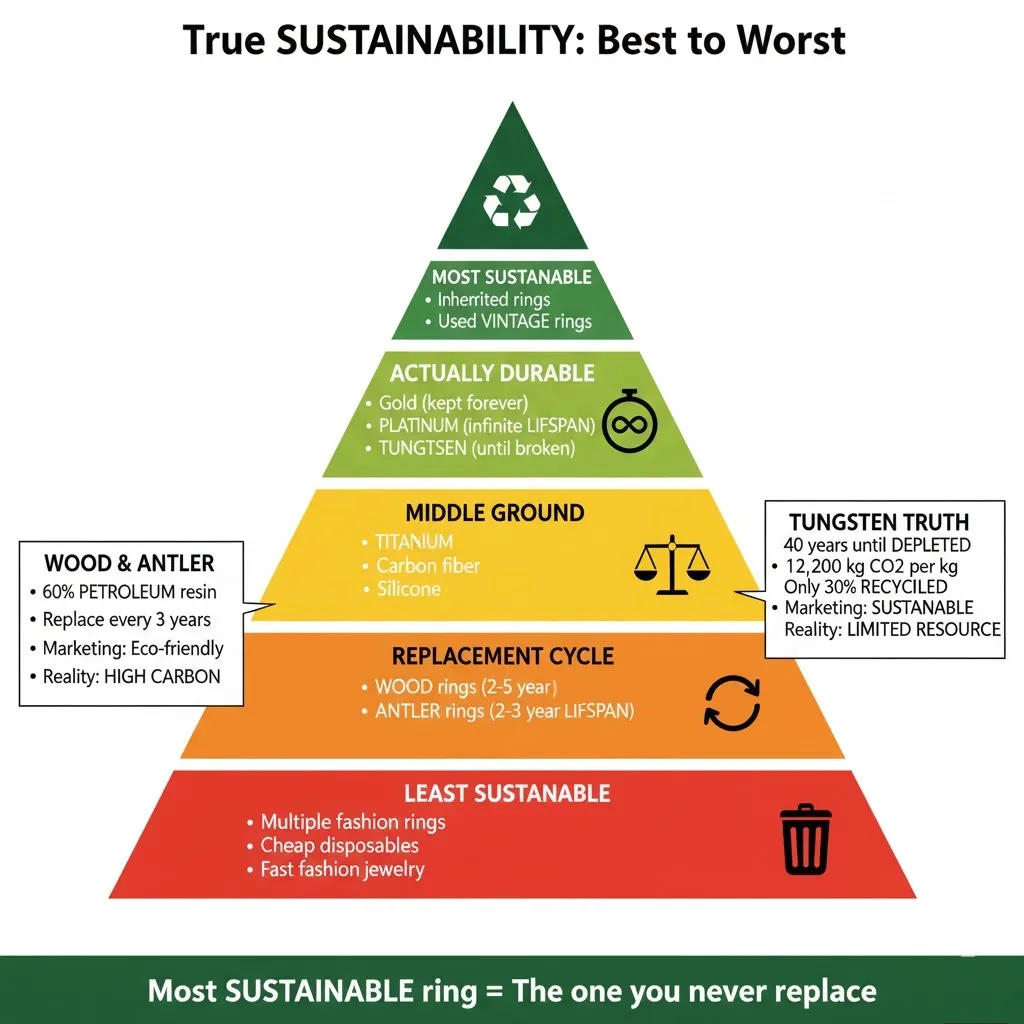
- Most sustainable: Inherit a ring. Buy used. Buy nothing.
- Actually durable: Tungsten (until it breaks), gold (can be reworked forever), platinum (true forever metal)
- Least sustainable: Wood and antler (require replacement every few years, petroleum-heavy production)
- Marketing sustainable: Titanium (better than some, worse than claimed)
What You’re Really Paying For
You’re paying for the story, not the materials.
The Men’s Ring Market: What’s Actually Trending (2024-2025)
The global men’s jewelry market hit $48.56 billion in 2024, growing at 9.9% annually. The ring segment alone: $9.72 billion.
What’s Driving Sales
- Celebrity influence: Harry Styles, Michael Jordan, Paul Mescal normalizing men’s jewelry
- Gender fluidity: Traditional men’s jewelry rules dissolving
- Social media: Instagram and TikTok driving trends
- Self-expression: Rings as identity markers, not just wedding bands
- Disposable income: Men spending more on accessories
Material Trends
Currently popular:
- Mixed metals (combining titanium, tungsten, precious metals)
- Signet rings (resurgence in 2025)
- Minimalist bands
- Bold statement rings
- “Sustainable” materials (however defined)
Growing:
- Lab-grown diamonds
- Moissanite
- Alternative materials (wood, antler, meteorite, dinosaur bone)
- Carbon fiber
- Damascus steel
Marketing terms that mean nothing:
- Aerospace-grade (no certification)
- Military-grade (no standard)
- Medical-grade (refers to hypoallergenic properties only)
- Surgical steel (marketing term, not medical designation)
The Marketing Myths Breakdown
“Aerospace-Grade Titanium”
- The claim: Premium material used in aircraft, space shuttles, military applications.
- The reality: Aluminum beverage cans are also aerospace-grade. The term has no certification or quality standard for jewelry. Titanium alloys used in rings cost $7,500 per metric ton; your ring uses $0.08 worth.
“Scratch-Proof Tungsten”
The claim: Will never scratch, maintains polish forever, virtually indestructible.
The reality: Won’t scratch from daily wear. Will shatter from sharp impact. “Indestructible” until you drop it, then it’s $200 worth of fragments.
“Natural Wood Rings”
The claim: Eco-friendly, natural, sustainable, organic.
The reality: 60%+ petroleum-based epoxy resin. Requires petroleum-derived sealants. Needs replacement every few years. Wood element is stabilized with chemicals.
“Ethically Sourced Antler”
- The claim: Naturally shed, no animals harmed, eco-conscious choice.
- The reality: The “naturally shed” part is usually true. The “eco-conscious” part ignores the petroleum resin stabilization, chemical sealants, and planned 2-3 year obsolescence.
“Hypoallergenic”
- The claim: Safe for everyone, no allergic reactions.
- The reality: True for pure titanium and tungsten. False for tungsten rings using cobalt binders (cheap versions). Gold can still cause reactions if nickel is present in the alloy. Always verify binder material.
What Actually Matters When Choosing a Ring

Ask These Questions
How long will it actually last with my lifestyle?
- Desk job with occasional activities: Tungsten, titanium work fine
- Physical labor/active lifestyle: Tungsten will shatter, wood/antler won’t survive, titanium scratches
- Want to wear it daily forever: Gold, platinum, or accept replacement cycles
Can it be resized?
- Tungsten: No
- Titanium: Usually no (rarely half-size up)
- Wood: No
- Antler: No
- Gold/platinum: Yes, infinitely
What’s the real maintenance?
- Tungsten: None until it breaks
- Titanium: Periodic refinishing for scratches ($35-50)
- Wood: Biweekly waxing, professional refinishing every 6-18 months ($50-100)
- Antler: Biweekly waxing, extreme care required, refinishing as needed
What’s the actual cost over 10 years?
| Material | Initial | Maintenance/Replacement | 10-Year Total |
|---|---|---|---|
| Tungsten | $200 | $200 (1 replacement) | $400 |
| Titanium | $250 | $150 (3 refinishings) | $400 |
| Wood | $300 | $600 (3 refinishings + 1 replacement) | $900 |
| Antler | $400 | $800 (2 replacements) | $1,200 |
| Gold | $1,000 | $100 (1 refinishing) | $1,100 |
Gold costs more upfront. Wood and antler cost more over time.
What’s it worth if I need to sell it?
- Tungsten: 20-30% of purchase price
- Titanium: 40-50% of purchase price
- Wood: Almost nothing (nobody wants used wood)
- Antler: Almost nothing (condition deteriorates)
- Gold: 80-90% of melt value (always has intrinsic worth)
The Truth About “Sustainable” Ring Materials
Carbon Footprint Reality
Tungsten:
- Mining/production: 166 MJ energy per ring
- 12,200 kg CO2-eq per kg
- 30-35% recycling rate
- Will be depleted in 40 years
Titanium:
- Production: 12 tons CO2 per ton metal
- Recycling saves 95% of energy
- 100% recyclable without quality loss
- 90% goes to non-recyclable pigment use
Wood:
- Raw material: Low impact (if sustainably harvested)
- Processing: Petroleum-based resin (high impact)
- Lifespan: 2-5 years (high replacement impact)
- Total footprint: Higher than advertised due to replacement cycle
Antler:
- Raw material: Near-zero impact (naturally shed)
- Processing: Petroleum resin stabilization + sealants (high impact)
- Lifespan: 2-5 years (high replacement impact)
- Total footprint: Low material impact, high processing impact
Most Sustainable Options (Actual)
- Used/vintage/inherited rings: Zero new production
- Gold or platinum (if kept forever): Made once, lasts indefinitely, recyclable
- Long-lasting synthetic (silicone, carbon fiber): Low cost, low impact, practical
- Tungsten (if you don’t break it): Made once, lasts until impact
- Titanium: Decent longevity, recyclable
Least Sustainable Options (Actual)
- Wood and antler: Require replacement every few years, petroleum-heavy production
- Buying multiple rings: Fashion rings that sit in drawers
- Disposable alternatives: Cheap versions that need frequent replacement
The most sustainable ring is the one you actually wear until it literally cannot be worn anymore.
What the Industry Won’t Tell You
The Resizing Problem
Cannot be resized:
- Tungsten carbide (too hard)
- Most titanium (specialized equipment needed)
- Wood (organic material + resin)
- Antler (organic material + resin)
- Carbon fiber (composite material)
Your finger size changes? Buy a new ring. Gain or lose weight? New ring. Age changes your fingers? New ring.
The ring industry loves alternative materials because every size change is a new sale.
The Emergency Room Issue
Tungsten and ceramic rings can’t be cut off in emergencies. They must be cracked or shattered using special tools. Not all emergency rooms stock the right equipment. Some use vice grips. Some have to transfer patients.
Medical professionals prefer rings that can be cut: gold, silver, platinum, even titanium (with carbide-tipped cutters).
The “Lifetime Warranty” Deception
Many alternative material rings come with lifetime warranties. Sounds great until you read the fine print:
What’s covered: Manufacturing defects
What’s not covered:
- Damage from impact (tungsten’s main failure mode)
- Scratches (titanium’s main issue)
- Water damage (wood’s main failure)
- Normal wear (antler’s main problem)
- Size changes (the most common need)
What the warranty actually means: If the ring was defectively made, they’ll replace it. Everything else—the actual reasons these rings fail—you pay for.
The Maintenance Revenue Stream
“Lifetime refinishing” sounds generous. Companies offer it because:
- You pay shipping both ways ($10-20)
- Refinishing takes 2-4 weeks (you buy a backup ring)
- Multiple refinishings means brand loyalty
- Each interaction is a cross-sell opportunity
Your $250 titanium ring generates $200-400 in additional revenue over its lifetime.
Wood and antler rings with “lifetime services” work the same way. The service exists because the product needs it.
The Bottom Line
The men’s ring industry sells you materials based on marketing stories, not material properties.
- Tungsten isn’t indestructible — it shatters.
- Titanium isn’t aerospace-grade premium — it’s $0.08 of metal marked up 2,000%.
- Wood rings aren’t natural — they’re 60% petroleum resin.
- Antler rings aren’t eco-friendly — they’re plastic-soaked bone with a 3-year lifespan.
The materials aren’t the problem. The lies about the materials are the problem.
What You Should Do
- Ignore the marketing terms: Aerospace-grade, military-grade, medical-grade mean nothing in jewelry.
- Calculate total cost: Include maintenance and replacement over 5-10 years.
- Match material to lifestyle: Active? Don’t buy tungsten or wood. Desk job? Most materials work.
- Accept the trade-offs: Every material has weaknesses. Companies hide them.
- Consider precious metals: Gold costs more upfront but less over time. Actually sustainable if kept forever.
- Buy what you’ll actually wear: The most sustainable ring is the one that doesn’t get replaced.
The ring companies that sell $8 tungsten for $200 want you focused on scratch resistance and aerospace technology. They don’t want you calculating that your “natural” wood ring costs $4 to make and requires $400 in maintenance over five years.
Do the math. Ignore the marketing. Buy based on your actual needs.
Every “revolutionary” alternative material is a traditional ring company with better copywriting and bigger profit margins.


About author

Add comment